
What are the selection criteria for SAF purchased by Air France?
SAF produced and consumed in the European Union must meet the sustainability criteria set by European regulations, which are the strictest in the world. These regulations require that SAF production does not compete with human food chains and that they are not produced from palm oil.
Air France takes it one step further by applying these sustainability criteria to all the SAF it selects, including SAF outside of Europe, relying on certification from internationally recognized organizations such as ISCC (International Sustainability and Carbon Certification) and the RSB (Roundtable on Sustainable Biomaterials).
European regulations also require a minimum 65% reduction in CO2 emissions over the SAF's life cycle compared to kerosene.
SAF: a determining factor for the decarbonization of air travel
However, SAF production remains very limited, accounting for only 0.3% of global aviation fuel production in 2023. To encourage increased production, Air France is committed to using as much SAF as possible from today.
The aviation fuel used on flights departing from France already incorporates a mandatory SAF component. In 2025, fuel suppliers’ deliveries to European airports must contain at least 2% SAF. SAF is blended with kerosene, injected into the airport fuel supply systems, and used to power aircraft without distinction.
Is there a SAF contribution on your ticket?
An environmental surcharge is already included in the price of all our flights. Its amount is listed in your ticket price breakdown on the line: “Environmental surcharge.”
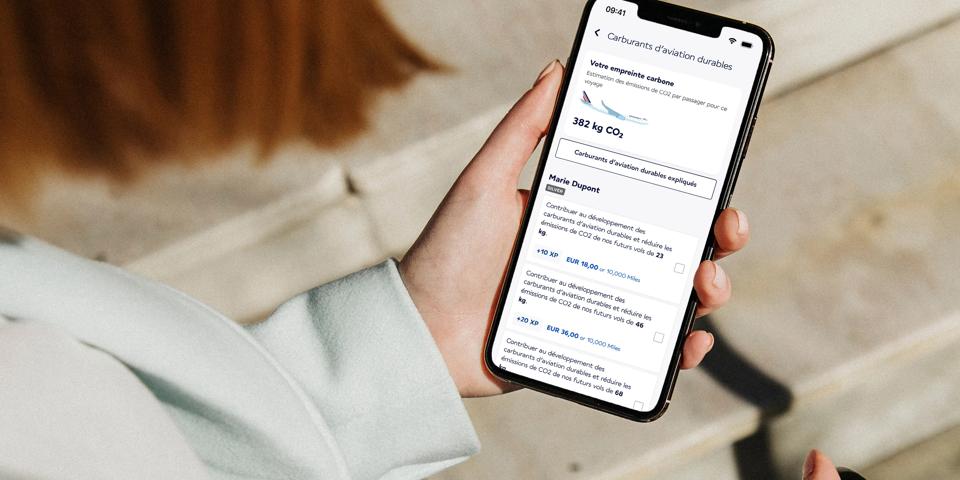
To take things even further and purchase even more SAFs, Air France also offers a voluntary contribution when booking your trip. Each contributed euro will be entirely allocated to the purchase of SAF. If you are a Flying Blue member, you can use your Miles to contribute to the purchase of SAF and earn additional XP.
Air France’s goals
We aim to incorporate up to 10% of SAF globally by 2030.
Thank you for your commitment
Thanks to your contributions and those of our corporate clients, we used 79,618 tons of SAF in 2025, and, through this initiative alone, avoided emitting more than 269,000 tons of CO₂, the equivalent of 860 round-trip flights between Paris and New York.